Skip to content








The 60-Second Scoot and Gland Check.
Built with our in-house veterinary nurse, to show you exactly why your dog is scooting, and the hands-off way to fix it.
Answer 11 quick questions about your dog.
Get a personalised read on what is causing the scooting and the smell, matched to their age, breed, weight and what you have been noticing.
No email needed. Takes under a minute.
Vet-formulated · 12-in-1 formula · Made in Ireland · 90-Day Visible Results Guarantee
Your dog's name comes next. We use it throughout.

First, what's your dog's name?
We'll use it throughout your check.
How old is {dog_name}?
And how much does {dog_name} weigh?
What breed is {dog_name}?
- French Bulldog / Bulldog
- Pug
- Cavapoo / Cockapoo / other poodle cross
- Cavalier King Charles Spaniel
- Dachshund
- Shih Tzu / Lhasa Apso
- Chihuahua / Yorkshire Terrier / other toy
- Labrador / Lab cross
- Cocker / Springer Spaniel
- German Shepherd / Collie
- Staffordshire Bull Terrier
- Jack Russell / other terrier
- Mixed breed
- Other
Is {dog_name} male or female?
Sex
Got it. {dog_name}'s on file.
What have you been noticing with {dog_name}?
Select everything that sounds familiar, even the small stuff.
When did you first notice this with {dog_name}?
Noted.
What have you tried for it so far?
Be honest, this is the most important question in the check.

Scooting isn't a hygiene thing. It's a pressure thing.
Here's what almost nobody tells you. {dog_name} isn't scooting because they're dirty, or ashamed, or need a bath. They're scooting because of a mechanical failure most owners never hear explained.
Two small glands sit either side of their bottom. They're meant to empty on their own, every time {dog_name} does a firm poo, because the bulk of the stool presses them against the sphincter wall and squeezes them out.
When the stool is soft or loose, there's no pressure. The glands don't empty. The fluid inside thickens into a paste, and the only way {dog_name} can get relief is to drag their bum along the floor. That's the scoot. That's the smell.
This is why manual expressions feel like a trap. They empty the glands for a day or two, but they don't restore the pressure, so the glands fill straight back up, usually within a week.
Fix the stool, and you fix the pressure. Fix the pressure, and the glands empty on their own, every day, the way they're meant to. And because the gut, skin and glands all run on the same system, the same chew that firms the stool supports coat and digestion too. One chew, not a shelf of tubs.
Here's why Glandex didn't hold for {dog_name}.
Glandex isn't a bad product. It just doesn't do enough of the one thing that matters.
Restoring gland pressure needs a fibre that forms a thick, gel-bound stool with genuine bulk. Glandex leans on pumpkin and a modest fibre dose, which softens the edges but rarely builds the viscosity needed to actually press the glands.
That's the difference between adding a little water and adding real structure. Without the structure, the stool stays too soft to squeeze the glands, so the scooting comes back.
PetGently is built around high-viscosity psyllium husk, the fibre chosen specifically for that gel-forming, pressure-restoring job. That's the piece Glandex was missing.
Here's why No Scoot didn't fix it for {dog_name}.
No Scoot chews target the right problem, but with the wrong dose of the right idea.
Emptying the glands naturally comes down to one thing: a firm, bulky stool that presses them on the way past. That takes a fibre with real gel-forming viscosity, at a functional dose. Most scoot chews, No Scoot included, use too little fibre to build that bulk.
So the stool gets a bit firmer, but never firm enough to restore the pressure. The glands stay full. The scooting returns.
PetGently uses high-viscosity psyllium husk at 120mg, chosen for exactly this job. It builds the stool structure that No Scoot couldn't.
Here's what the fibre chew you tried got wrong for {dog_name}.
A fibre chew is the right instinct. The problem is that not all fibre does the same job.
To empty the glands, the stool has to be firm, bulky and cohesive enough to press them against the sphincter wall. That needs a gel-forming fibre like psyllium, at a real dose. Most fibre chews use blends that add a little softness but never build the viscosity that creates pressure.
It's the difference between adding water and adding structure. Without structure, no pressure. Without pressure, the glands stay full.
PetGently is built around high-viscosity psyllium husk (120mg) plus pumpkin seed, the combination that actually forms the pressing stool.
{dog_name} didn't reject the fix. They rejected the chew.
Here's the thing no one says: the best scoot formula on earth does nothing if it stays in the bowl.
A lot of chews are hard, dry or oddly flavoured, and fussy dogs simply refuse them. That's not {dog_name} being difficult. It's the product failing the one test that comes before everything else: being eaten.
So the right formula has to do two jobs. It has to build the firm, high-viscosity stool that presses the glands, AND it has to be something {dog_name} actually wants.
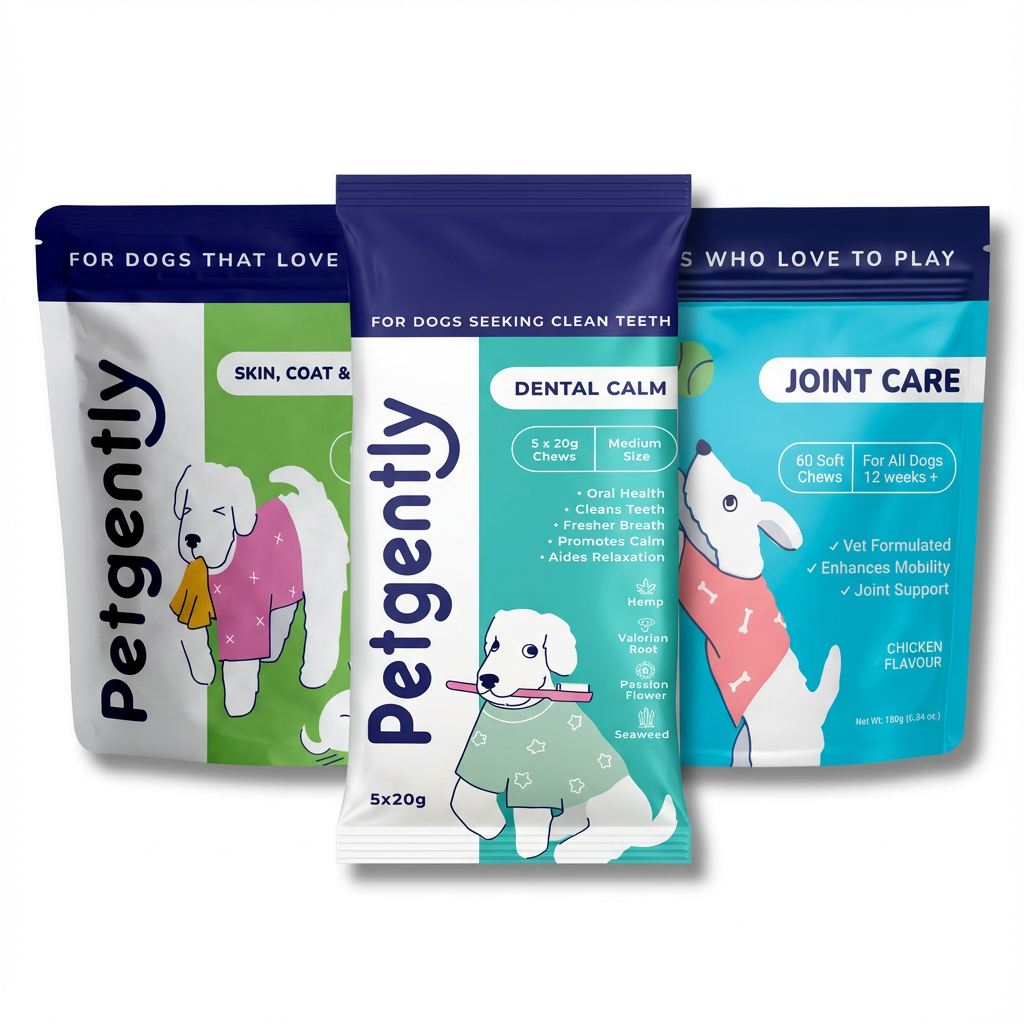
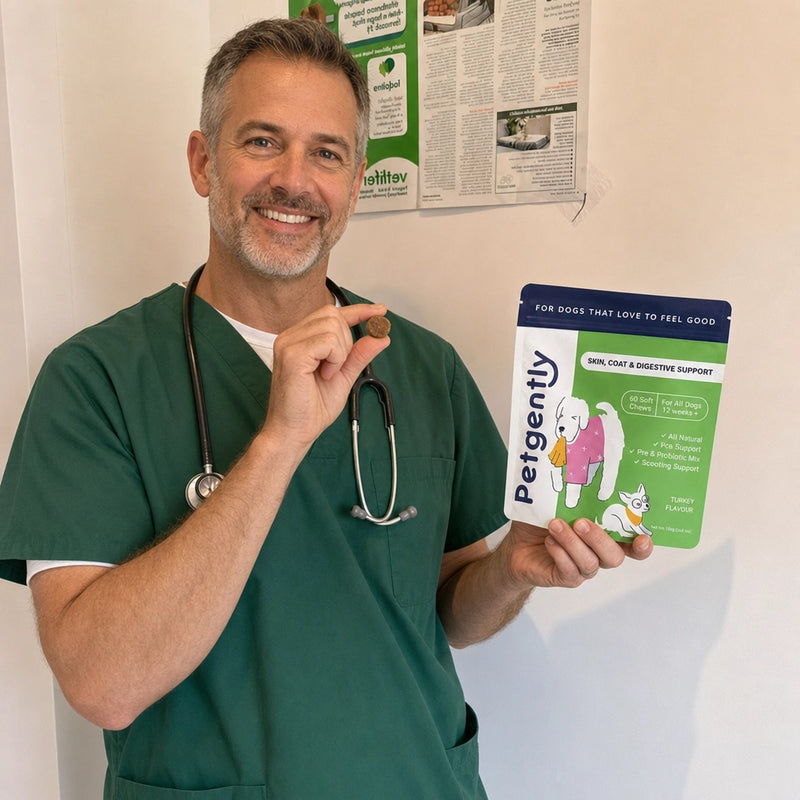
PetGently is a soft, turkey-flavoured chew. Most dogs take it straight from the hand, so the psyllium inside gets the chance to do its job.
Adding pumpkin was the right idea, done with the wrong fibre.
Reaching for pumpkin shows good instinct: you understood the fix is about stool, not hygiene. But pumpkin alone rarely gets there.
Pumpkin is mostly water and soft fibre. It can gently firm things up, but it doesn't build the thick, gel-bound bulk that presses the glands hard enough to empty them. So the stool improves a little, the pressure doesn't return, and the scooting continues.
The mechanical work needs a high-viscosity fibre. Psyllium husk forms a firm, cohesive gel that pumpkin can't, which is exactly why we build the formula around it, with pumpkin seed backing it up.
Same instinct you already had. The fibre that actually does the job.
Here's why probiotics didn't stop the scooting for {dog_name}.
Probiotics and general supplements support gut health, which is worth doing. But scooting isn't really a gut-flora problem. It's a stool-pressure problem.
The glands empty when a firm, bulky stool presses them on the way past. Probiotics don't build that bulk. They can help digestion around the edges, but they don't create the mechanical pressure the glands need, so the scooting keeps happening.
PetGently works on the actual mechanism: high-viscosity psyllium husk forms the firm, pressing stool that empties the glands. And as a 12-in-1, it covers the gut support too, in the same chew.
Expressing the glands relieves it. It never ends it.
Manual expression, whether at the vet or at home, is a relief, not a repair. It empties the glands for a day or two, but it does nothing about why they filled: the stool wasn't firm enough to press them.
So they fill straight back up, usually within a week. That's not a failure on your part. It's the mechanism. It's the Manual Expression Trap, and it's exactly why it feels like it never ends.
The way out is to stop emptying the glands for {dog_name} and start rebuilding the pressure so they empty on their own. That takes a firm, bulky stool, which takes high-viscosity psyllium husk.
PetGently is built around it, so the glands do their own job again, on every bowel movement.
Before you buy the first scoot chew you see, here's the one thing to check.
Starting fresh is the best position to be in, because you can get it right the first time.
Here's the one thing that separates the chews that work from the ones that don't: fibre viscosity. The glands empty when a firm, bulky, gel-bound stool presses them on the way past. That takes a high-viscosity fibre like psyllium husk, at a real dose. Most scoot chews use too little, or the wrong kind, and never build the pressure.
PetGently is built around high-viscosity psyllium husk (120mg) plus pumpkin seed, the combination that actually restores the pressure, from day one.
One more about {dog_name}'s routine.
When is the scooting or the smell at its worst?
Makes sense.
Is {dog_name} currently having any treatment for this?
We ask because a couple of situations are worth a quick word with your vet first.
Almost there.
Last one. What matters most to you about sorting this for {dog_name}?
Pick the one that hits hardest.
Mapping {dog_name}'s profile...
Matching to the 12-in-1 formula...
Building {dog_name}'s result...
11 answers in. Reading the pressure pattern.