The Itch Pattern Test.
The itching has a pattern. 12 questions, built with PetGently's veterinary team, read it and point to what's actually driving it.
When it flares. What's been tried. What changed nothing.
Those three things say more about your dog's itching than the itching itself. The test reads them and gives you a personalised picture for your dog's age, breed and history.
No email needed. About a minute.
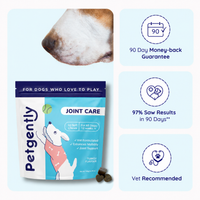
Vet-formulated · 12-in-1 formula · Made in Ireland · 90-Day Visible Results Guarantee
Your dog's name comes next. We use it throughout.
First, what's your dog's name?
We'll use it all the way through.
How old is {dog_name}?
And how much does {dog_name} weigh?
What breed is {dog_name}?
- French Bulldog / Bulldog
- West Highland Terrier / Westie
- Shar Pei
- Golden Retriever
- Labrador / Lab cross
- Boxer
- Staffordshire Bull Terrier / Staffy
- Cocker / Springer Spaniel
- German Shepherd
- Pug
- Shih Tzu
- Cavalier King Charles Spaniel
- Dalmatian
- Cockapoo / Cavapoo / Labradoodle
- Mixed breed / Other
Is {dog_name} male or female?
Sex
Hello, {dog_name}.
What is the itching actually like for {dog_name}?
Tick everything that's true. The small things count here.
What's the pattern with {dog_name}'s itching?
That tracks.
What have you already tried for {dog_name}'s skin?
List it all. What didn't work tells us as much as what did.
Your dog isn't itching because of one thing. They're itching because the bucket is full.
Here's why the things you've tried haven't held.
Almost everyone treats a dog's itching as an allergy problem: find the trigger, remove the trigger, the itching stops. So you change the food. You try the shampoo. You wipe the paws. And it helps a bit, for a while, and then it doesn't.
That's because the itch doesn't come from any single trigger. It comes from total inflammatory load.
Picture a bucket with three taps filling it. One is the gut, where an inflamed, imbalanced gut lining leaks inflammation into the bloodstream and it surfaces in the skin. One is the mast cells, the immune cells in the skin that hold histamine and burst too easily. One is the skin barrier itself, when it's dry and porous and lets more in.
Every tap adds to the level. When the level crosses the threshold, your dog itches.
Pollen doesn't fill the bucket. It's just the drop that tips it over an already-full one. That's why the same walk is fine one week and unbearable the next. And it's why removing one trigger never fixed it: the bucket was still nearly full.
Lower the level, and ordinary triggers stop tipping it over.
One more about {dog_name}'s routine.
When is the scratching at its worst?
That fits.
Is {dog_name} on anything from the vet for it?
No judgement either way. It changes what we'd suggest alongside it.
Nearly done.
While we are here, is {dog_name} dealing with anything else?
The gut, skin and glands run on one system, so it's worth knowing.
Last one. What would make the biggest difference to you?
Pick the one that hits hardest.
Mapping {dog_name}'s profile...
Reading the inflammation pattern...
Building {dog_name}'s result...
12 answers in. Matching to the 12-in-1 formula.

Skip to content